More than half the world’s population now lives in cities. By 2050, that figure will approach 70 percent.
Understanding how cities grow — and why the most successful ones rarely grow by accident — is the foundation for understanding what Dubai Vision 2040 is really about.
By Muzaffar Hussain — Investment Advisor & Observer of Urban Development, Dubai
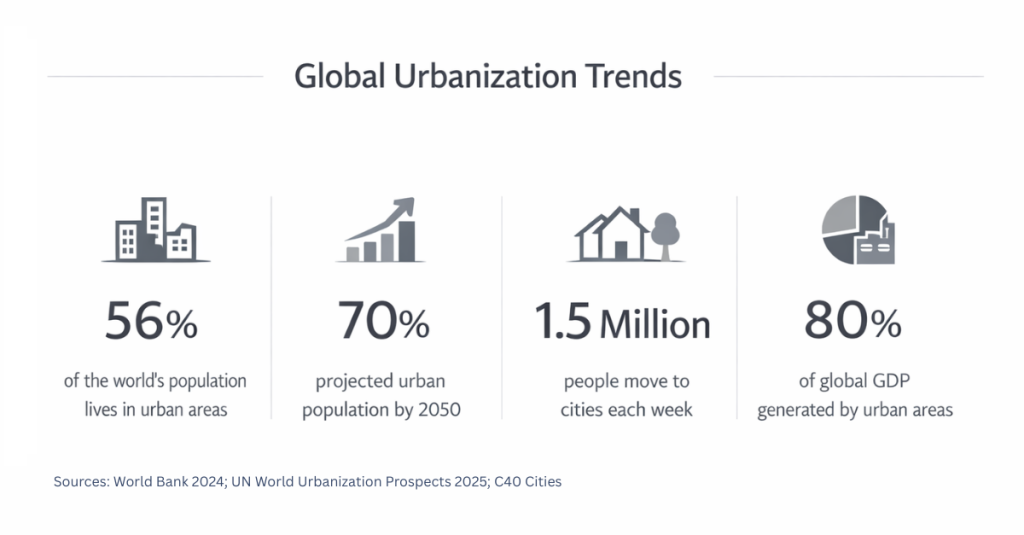
56% — World population in cities today
70% — Projected urban share by 2050
2.5B — People joining cities by 2050
80% — Global GDP generated by cities
Sources: World Bank 2024; UN World Urbanization Prospects 2025; C40 Cities
The urban century
In 1800, fewer than 5 percent of the world’s population lived in cities. By 1950, that figure had risen to around 30 percent. Today, it stands at 56 percent.
By 2050, two in every three people on Earth will live in an urban area — adding approximately 2.5 billion people to cities in just 25 years.
This is the defining demographic shift of our era.
Not a trend.
A structural reorganization of how humanity lives.
Cities already generate more than 80 percent of global GDP while consuming the majority of the world’s energy. They are engines of prosperity, centres of decision-making, and increasingly, the front line of environmental and social pressure.
What happens inside cities — how they are structured, how they expand, how they are planned — determines the quality of life for most of the global population.
And yet, for most of history, cities did not grow according to plan. They evolved organically, shaped by trade, migration, conflict, and necessity.
The modern question is different:
Is organic growth still sufficient — or does scale now demand design?
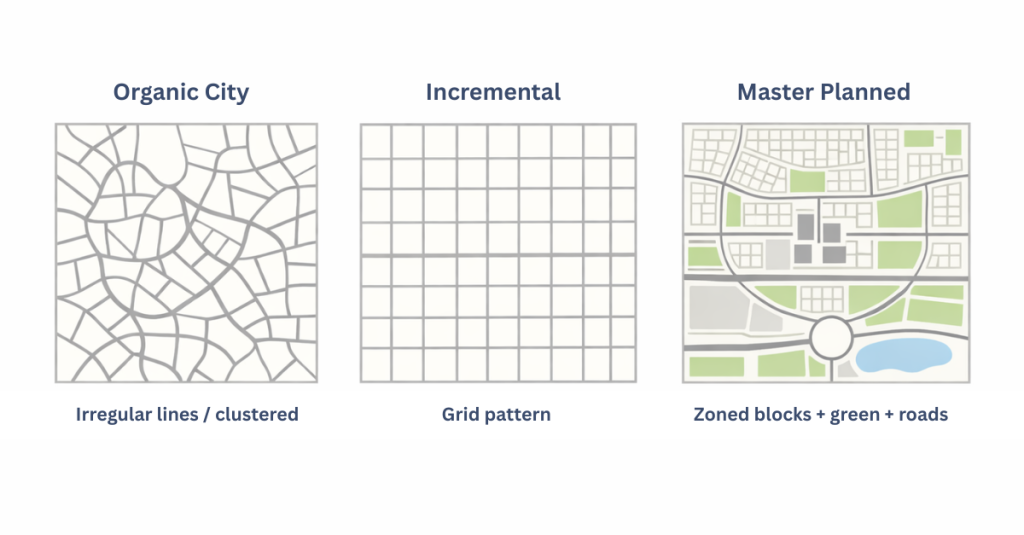
How cities grow: three patterns
Not all cities grow the same way. Over time, three dominant patterns have emerged — each with very different implications for livability, investment, and long-term value.
Organic growth
The oldest form of urban development.
Historic cities — from medieval Europe to Old Delhi and Cairo — expanded incrementally, responding to immediate human needs. Markets formed where people gathered. Housing clustered near work. Communities developed around social and religious anchors.
The result is often highly walkable, human-scale environments with strong identity.
But there is a trade-off.
Organic growth struggles under modern pressure. Infrastructure becomes difficult to upgrade. Density increases without coordination. Informal settlements emerge.
Urbanists often romanticize these cities.
Investors, in practice, experience their constraints.
Incremental planned growth
As cities industrialized, governments began imposing structure: zoning laws, street grids, building codes, and public infrastructure frameworks.
Paris under Haussmann, Manhattan’s grid, and London’s suburban expansion all followed this model.
The principle is simple:
Set the rules, then allow the market to build within them.
This approach creates order without requiring full central control. It balances flexibility with predictability — a combination that has historically supported stable urban expansion.
Master-planned growth
The most deliberate model.
A master plan coordinates land use, infrastructure, population distribution, economic function, and environmental strategy across an entire city — typically over a 10 to 30 year horizon.
Contrary to common perception, master planning is rarely about building cities from scratch. More often, it is about reorganizing existing cities for their next phase of growth.
Singapore, Barcelona, Seoul, and Dubai are all examples.
Master planning is not without criticism. Plans can be rigid, politically influenced, or disconnected from how people actually use cities.
But over time, one pattern becomes clear:
Cities that plan long-term — and consistently implement those plans — tend to outperform those that do not.
What is less obvious is how rare that consistency actually is.
Why cities plan
Master planning does not emerge in a vacuum. It is usually a response to pressures that organic or incremental growth can no longer absorb.
Population growth
When population expands faster than infrastructure and housing, the result is predictable: congestion, inequality, and declining quality of life.
Planning ahead — before the population arrives — is not optional. It is the only way to absorb growth without disruption.
Delaying planning does not reduce the problem.
It increases the cost of solving it later.
Economic restructuring
Cities evolve economically.
Industrial centres transition to service economies. Port cities adapt to changing trade networks. Financial hubs emerge where manufacturing once dominated.
These shifts require spatial reorganization: new districts, repurposed land, upgraded infrastructure.
This cannot happen street by street.
It requires coordinated planning.
Sustainability and climate pressure
Urban areas occupy less than 2 percent of the Earth’s surface, yet generate the majority of emissions.
Low-density, car-dependent cities carry significantly higher environmental costs. They are also more vulnerable to climate risks.
Master planning is increasingly the primary tool for shifting cities toward:
- Density
- Transit
- Green infrastructure
Competition for talent and capital
Cities now compete globally.
Talent and investment follow quality of life: housing, mobility, safety, public space, and accessibility.
Cities that plan for livability attract human capital.
Cities that do not lose it — often permanently.
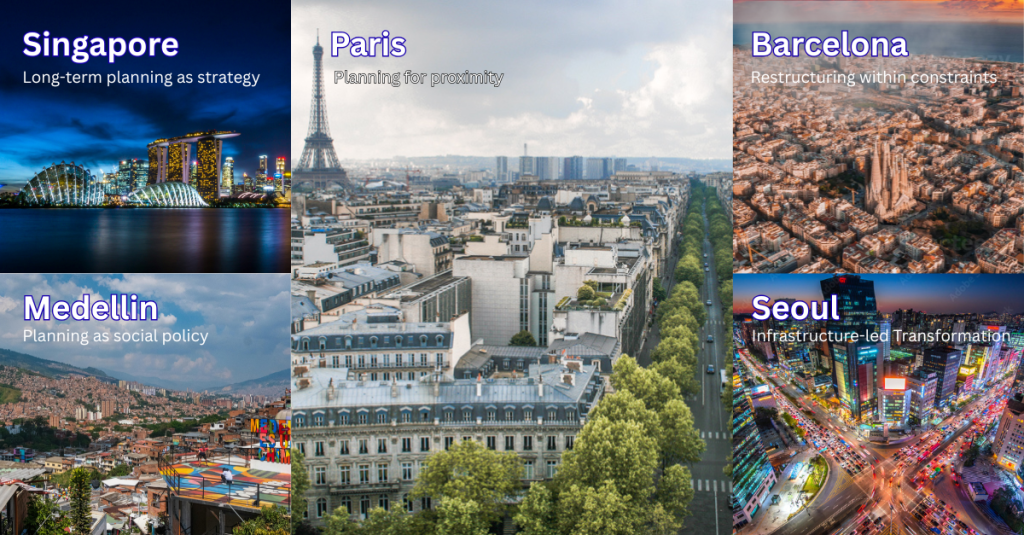
Five cities that planned their transformation
Master planning is not theoretical. It is observable — and measurable — across multiple cities.
- Singapore — long-term planning as strategy
In 1965, Singapore faced overcrowding, resource constraints, and limited infrastructure.
Its 1971 Concept Plan set a 20-year development framework. That plan was never abandoned — only revised and extended.
Today:
- Over 90 percent of residents own their homes
- The MRT system serves millions daily
- Infrastructure decisions made decades ago continue to shape the city
Singapore demonstrates a critical principle:
Planning works — but only when it is sustained.
- Barcelona — restructuring within constraints
Barcelona chose not to expand outward, but to transform inward.
Its Superblocks program reclaims urban space from cars and reallocates it to people.
In one district alone:
- Nitrogen dioxide fell by 25 percent
- Particulate matter dropped by 17 percent
Barcelona is not building a new city.
It is systematically rebuilding the one it already has.
- Seoul — infrastructure-led transformation
Seoul’s growth was rapid and large-scale. Its master plans coordinated housing, industry, and transport across decades.
The restoration of the Cheonggyecheon stream — replacing a highway with public space — became a global case study in urban regeneration.
It proved something important:
Even deeply embedded infrastructure decisions can be reversed — if the planning vision is strong enough.
- Paris — planning for proximity
The “15-minute city” model redefines urban optimization.
Instead of maximizing movement, it prioritizes access: ensuring daily needs are reachable within 15 minutes.
This shifts planning from infrastructure capacity to human experience — a fundamental change in how cities are designed.
- Medellin — planning as social policy
Medellin used planning to address inequality.
Cable cars connected isolated communities. Public infrastructure was deliberately placed in underserved areas.
The result was not just improved mobility — but measurable social transformation.
Planning, in this case, became a statement of priorities.
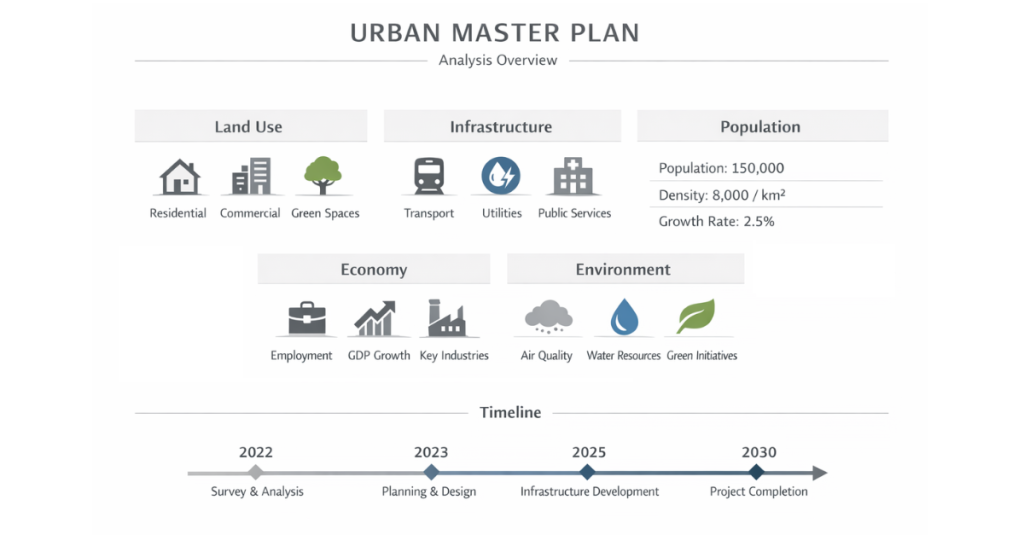
What a master plan actually contains
A master plan is not a single project. It is a framework for decision-making.
Typically, it includes:
- Land use and density allocation
- Infrastructure commitments
- Population projections
- Economic zoning
- Environmental strategy
- Phasing and timelines
It does not guarantee outcomes.
It defines direction.
The real complexity lies in the gap between plan and execution.
- Plans are written in offices.
- Cities are built in markets.
Understanding that gap — what is announced versus what is actually delivered — is where the most valuable insights exist.
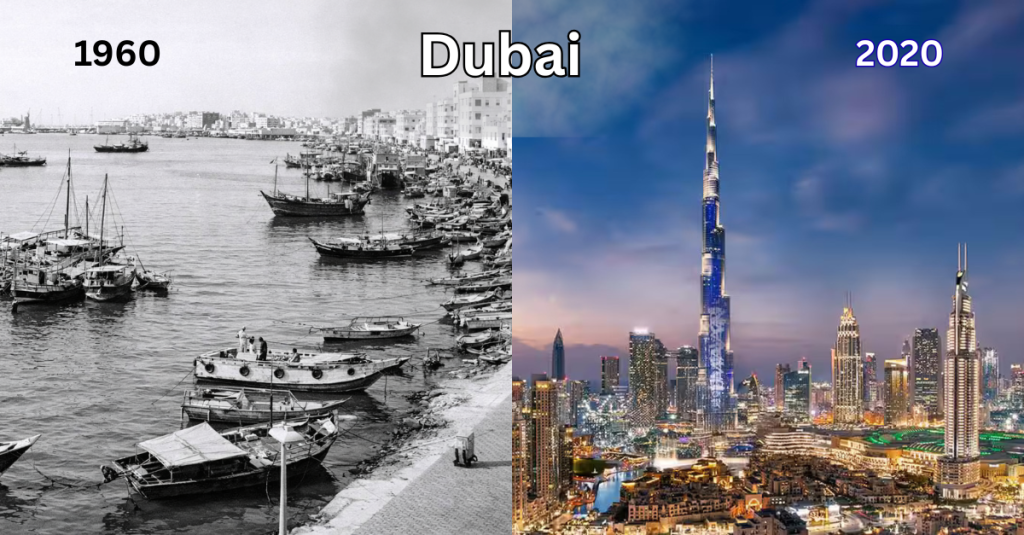
Dubai: a city built by design
Dubai is not an organic city.
It is the result of deliberate decisions — made early, and sustained over decades.
From a small trading town in the 1960s to a global city of over 3 million people, its growth has been driven by:
- infrastructure investment
- policy direction
- long-term planning frameworks
The strategy was clear from the beginning:
Use a finite window of oil-driven prosperity to build a diversified, self-sustaining city.
That strategy worked.
But every city reaches inflection points.
The Dubai of 2040 cannot simply extend the Dubai of today. New pressures — population, sustainability, global competition — require a new framework.
That framework is the Dubai Vision 2040 Urban Master Plan.
It is not the beginning of Dubai’s story.
It is the next phase of it.
Why this matters for investors and professionals
For those making decisions tied to urban growth, several principles consistently emerge.
Plans compound over time
The most successful cities are those where planning survives political cycles.
Infrastructure decisions made decades earlier continue to generate value.
The key insight:
Urban planning is not linear. It compounds.
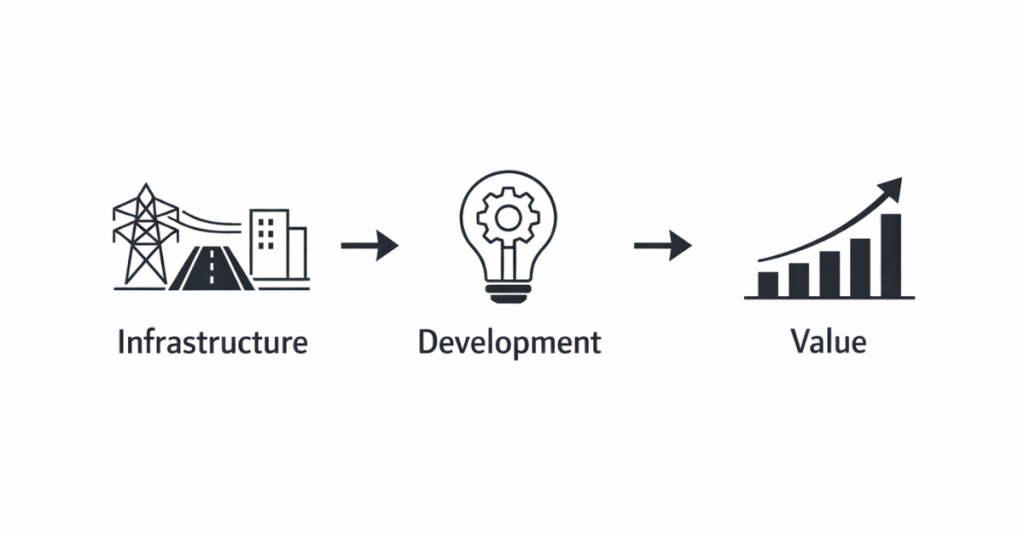
Infrastructure precedes value
This pattern is consistent across cities.
Infrastructure is committed first.
Development follows.
By the time an area appears “developed,” the highest-return phase is often already behind it.
Identifying where infrastructure is going next is the core analytical task.
The gap is where the intelligence lives
Plans signal intent.
Execution reveals reality.
Understanding:
- Which projects are progressing
- Where private capital is flowing
- How development is sequencing
…is where real insight exists.
This is not visible in announcements.
It requires continuous observation and interpretation.
In summary
Cities are now the primary arenas of human activity.
How they grow determines:
- Quality of life
- Economic performance
- Environmental outcomes
- Investment potential
Master planning is not a guarantee of success.
But consistently, across geographies and decades, one pattern holds:
Cities that plan — and follow through — outperform those that do not.
Dubai Vision 2040 represents that intent at scale.
Understanding it — in detail, in sequence, and in real time — is where meaningful urban intelligence begins.
Read next
From Pearl Port to Global City: How Dubai Built Itself (1960–2020)
Before understanding where Dubai is going, it’s essential to understand how it got here.
The next article traces Dubai’s transformation — from a small trading port to a global hub for tourism, finance, and real estate — shaped by policy, infrastructure, and long-term vision.
Continue reading → urbanintell.com/insights/dubai-growth-1960-2020